Last night I was out for a coffee catching up with my cousins (Civil Engineer and Architect). We were having a discussion about random topics when deep water cooling came up. Apparently this process is used in Toronto by a company by the name of Enwave (
View Here) to cool various office buildings/condo's in the downtown core by the means of pumping cold water from the lake. My cousin went into detail about how this process works, however I needed more information in order to solidify said concept.
So here it is (mostly linked from
Wikipedia/various websites.)
Deep Water Source Cooling
Deep water source cooling (DWCS) or deep water air cooling is a form of air cooling for process and comfort space cooling which uses a renewable, large body of naturally cold water as a heat sink. It uses water at 4 to 10 degrees Celsius drawn from deep areas within lakes, oceans, aquifers or rivers, which is pumped through the one side of a heat exchanger. On the other side of the heat exchanger, cooled water is produced.
 |
| Industrial Heat Exchanger |
Water is most dense at 3.98 °C (39.16 °F) at standard atmospheric pressure. Thus as water cools below 3.98 °C it decreases in density and will rise. As the temperature climbs above 3.98 °C, water density also decreases and causes the water to rise, which is why lakes are warmer on the surface during the summer. The combination of these two effects means that the bottom of most deep bodies of water located well away from the equatorial regions is at a constant 3.98 °C.
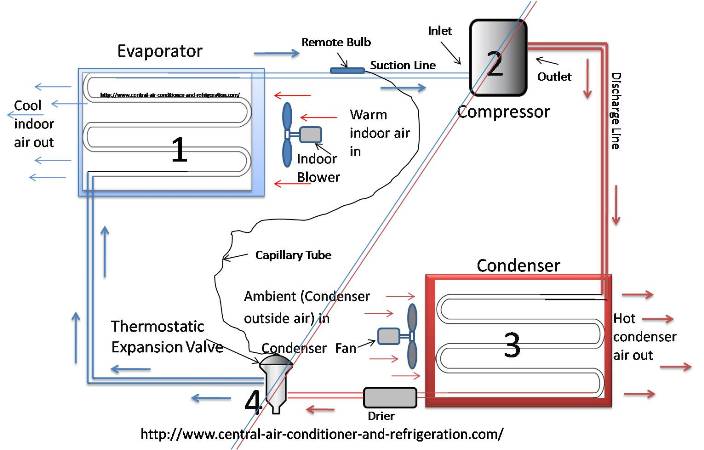
Air conditioners are heat pumps. During the summer, when outside air temperatures are higher than the temperature inside a building, air conditioners use electricity to transfer heat from the cooler interior of the building to the warmer exterior ambient. This process uses electrical energy.
Unlike residential air conditioners, most modern commercial air conditioning systems do not transfer heat directly into the exterior air. The thermodynamic efficiency of the overall system can be improved by utilizing evaporative cooling, where the temperature of the cooling water is lowered close to the wet-bulb temperature by evaporation in a cooling tower. This cooled water then acts as the heat sink for the heat pump.
 |
| Air Conditioner Cycle Diagram |
Deep lake water cooling uses cold water pumped from the bottom of a lake as a heat sink for climate control systems. Because heat pump efficiency improves as the heat sink gets colder, deep lake water cooling can reduce the electrical demands of large cooling systems where it is available. It is similar in concept to modern geothermal sinks, but generally simpler to construct given a suitable water source.
Deep lake water cooling allows higher thermodynamic efficiency by using cold deep lake water, which is colder than the ambient wet bulb temperature. The higher efficiency results in less electricity used. For many buildings, the lake water is sufficiently cold that the refrigeration portion of the air conditioning systems can be shut down during some environmental conditions and the building interior heat can be transferred directly to the lake water heat sink. This is referred to as "free cooling", but is not actually free, since pumps and fans run to circulate the lake water and building air.
One added attraction of deep lake water cooling is that it saves energy during peak load times, such as summer afternoons, when a sizable amount of the total electrical grid load is air conditioning.
 |
| DWCS Diagram |
Advantages
Deep water source cooling is very energy efficient, requiring only 1/10 of the average energy required by conventional cooler systems. The energy source is fully renewable, provided that the heat brought to the lake does not disturb its natural cycles. It does not use any ozone depleting refrigerant.
Depending on the needs and on the water temperature, couple heating and cooling can be considered. For example, heat could first be extracted from the water (making it colder); and, secondly, that same water could cycle to a refrigerating unit to be used for effective cold production.
Disadvantages
Deep water source cooling requires a large and deep water quantity in the surroundings. To obtain water in the 3 to 6 °C (37 to 43 °F) range, a depth of 50 m (160 ft) to 70 m (230 ft) is required, depending on the local conditions.
The set-up of a system is expensive and labour-intensive. The system also requires a great amount of source material for its construction and placement.
First System In Canada
Since August 2004, a deep lake water cooling system has been operated by the Enwave Energy Corporation in Toronto, Ontario. It draws water from Lake Ontario through tubes extending 5 kilometres (3.1 mi) into the lake, reaching to a depth of 83 metres (272 ft). The deep lake water cooling system is part of an integrated district cooling system that covers Toronto's financial district, and has a cooling power of 59,000 tons (207 MW). The system currently has enough capacity to cool 3,200,000 square metres (34,000,000 sq ft) of office space.
The cold water drawn from Lake Ontario's deep layer in the Enwave system is not returned directly to the lake, once it has been run through the heat exchange system. The Enwave system only uses water that is destined to meet the city's domestic water needs. Therefore, the Enwave system does not pollute the lake with a plume of waste heat.