Showing posts with label Technology. Show all posts

Monday, 25 August 2014

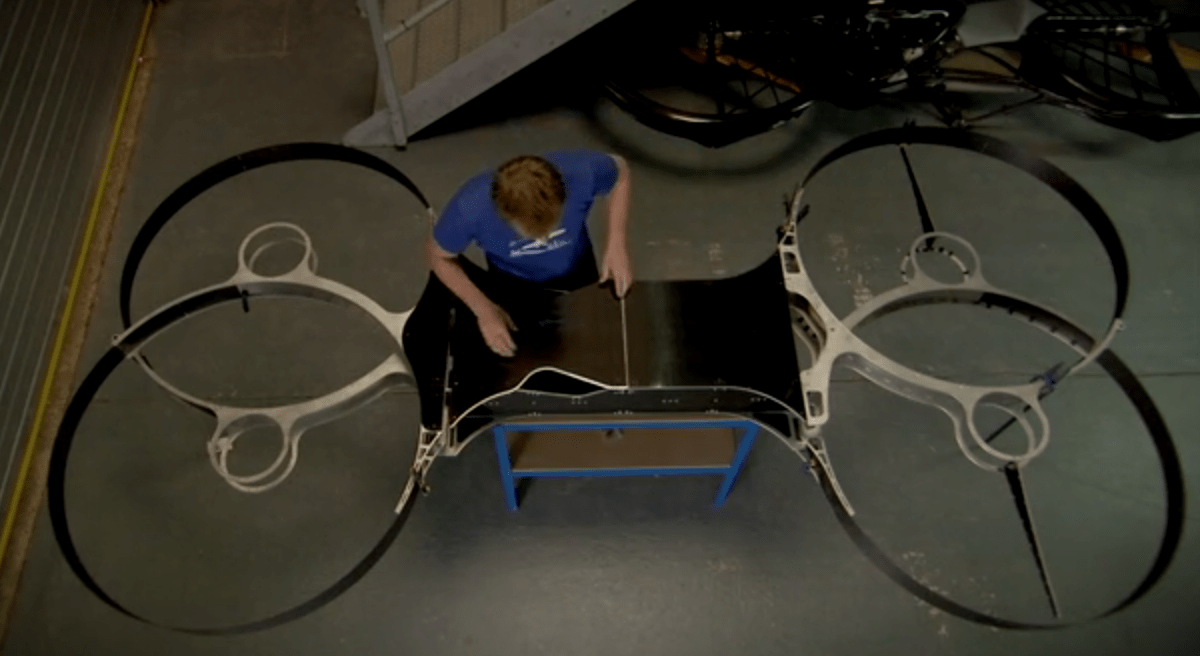
Cyborg Manned Hoverbike

Malloy Aeronautics have their eye on a truly groundbreaking (pun intended) concept, which actually makes quite a bit of sense. View their kickstarter here. 


The goal is to create a drone which can be piloted by either a human or remote controlled. Using simplified helicopter technology, the engineers were able to push the envelope on current drone tech to create such machinery capable of reaching altitudes of  9000ft with speeds up to 100 knots.

1/3 scale version


Be sure to participate in the kickstarter if you're interested in the company, project and/or future endeavours. I'm sure Google is keeping a close eye on this.

They even give you the schematics to create "Buster". Pretty neat.


I can see where the inspiration came from ...


~

Tuesday, 19 August 2014

OM/ONE : Levitating Bluetooth Speaker

The worlds first levitating bluetooth speaker.


I'm not really sure if this device truly is revolutionary, or simply an ingenious marketing scam. Either way, it looks to be of high quality, paired with a relatively clean obsidian finish. Let's see if I can get my hands on one, for review purposes.

The worst case scenario would be - I have a new levitating desk ornament.


Not a bad idea.. lol. 

Wednesday, 6 August 2014

Friday, 25 July 2014

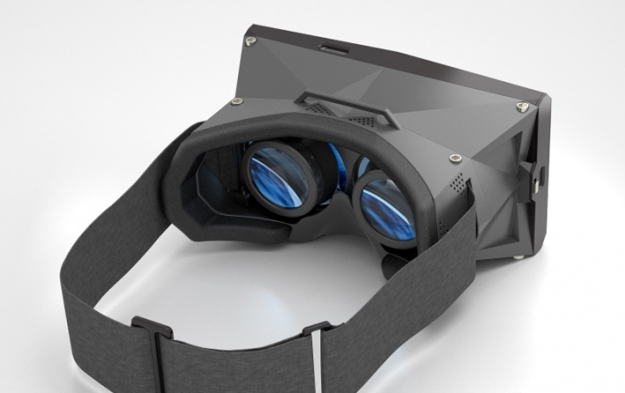
The Affordable Future of Virtual Reality; Google Cardboard

So we've all heard of Oculus Rift. The startup company by Luckey Palmer which refreshed the desire to create high quality, working virtual reality equipment; essentially for gaming.


 It was recently purchased by social media goliath Facebook, for approximately 2 billion USD.


Now, a dev unit costs around 300$+, while over at Google, their engineers fabbed up an interesting VR unit which goes for as little as 30$. 


What I like most about this product happens to be that it encourages users to be innovative. Writing code to create new applications that can utilize this device. Even though it is primarily dependent on an Android smartphone, and not necessarily created for high end gaming, there are an overwhelming amount of possibilities to be had.


                            Cardboard on Make A Gif

Anything is possible in this realm, essentially paving the way to a technologically advance future which consists of virtual realistic environments and a new way of interacting with computers. All this is possible, not just thanks to the massive tech corps, but to the curious consumer who desires to do a little more with their devices.


It's all in the eye of the beholder.


Make your own Google Cardboard HERE.

Monday, 2 June 2014

GoPro Files for $100 Million USD IPO

GoPro has filed paperwork with the SEC for a $100 million USD public offering. After earning a dramatic increase in profits over its 10 years in business and unlike the majority of big name tech companies, it is actually profitable, reporting a net income of just over $60 million USD in 2013. Keep your eye out for the impending IPO, which will be trading under the ticker GPRO on NASDAQ.


Three Dyson Inventions You'll Never See In Stores

Article by Megan Wollerton via CNET

Dyson just recently announced plans to expand beyond its trademark vacuums, but it turns out that the brand has been working on non-vacuum prototypes all along.

Dyson's DC41 Animal Complete vacuum cleaner.
 - Colin West McDonald/CNET

Dyson, the British luxury small appliance manufacturer, is best known for the colorful cyclonic filters it uses on its vacuum cleaners. But it wants the world to know it's been working on other kinds of products, too, revealing three never-before-seen prototypes to show off its innovation expertise.

Is it coincidental timing that Dyson is offering up this broader view of its R&D operations, less than 24 hours before news of an anticipated expansion by Apple into smart home tech? The projects listed here aren't exact corollaries to, say, a set of smart light bulbs, but as Google, Facebook, and other tech companies start expanding their horizons, why not one more?


James Dyson, the company's founder, famously went through thousands of vacuum prototypes (5,127, to be exact) to perfect his vision before bringing it to production. Today, he employs teams of scientists and engineers who continue to develop products within the industry, but the company has been building all sorts of other concepts for years now, too -- many of which have nothing to do with vacuums or its other high-end retail items.

James Dyson wearing the Dyson Halo N066 augmented reality headset.
Dyson Halo N066 smart glasses and watch

The N066 was a full-color 3D augmented reality headset that Dyson started working on in 2001. It projected a 10-inch display about 1 meter (3.3 feet) in front of you and let you select among a list of applications. Sound familiar?


The headset relied on a pocket-sized computer to give you information about things in your immediate area. Through audio and visual prompts, it helped wearers perform tasks, like reading emails. A virtual keyboard also allowed you to write emails on any surface.


You could disconnect the portable computer, dock it, and use it as a desktop computer of sorts.


The controller is another hardware component of N066. It was designed to be worn on the wrist like a watch and worked like a laptop pointing stick so you could move the virtual cursor across the virtual display.


The Dyson Halo was in development for three years before the project was stalled. The team of engineers were asked to focus on bringing the brand's existing product categories to the US instead. However, tech from N066 is being used in more recent projects.

The Dyson Diesel Trap X007
Dyson Diesel Trap X007 engine filter

Another Dyson prototype was inspired by the brand's signature cyclonic vacuum filters. Since the cyclone technology is used to remove allergens and other harmful particles from your floors, Dyson decided to apply the same theory to diesel fuel engines. The idea was that it would help filter out more of the hazardous environmental pollutants that diesel engines expel.

Early versions of X007 relied on cyclone tech, but needed too much energy to run properly. Several iterations later and Dyson had a working prototype. Dyson claims that it had a hard time getting people interested in this product -- as manufacturers were more interested in ceramic filters -- and stopped developing the X007.

The Dyson Digital Motor V4HF
Dyson Digital Motor V4HF

The goal of this project was twofold: to develop a digital motor for a fuel cell and to simultaneously decrease its size and increase its performance efficiency. Ten engineers worked on the digital motor project for three years. Eventually, the team came up with V4HF.

According to Dyson, this small, lightweight motor did improve efficiency and increase power density. It also made the notoriously slow fuel cell start-up time nearly three times faster. While this prototype hasn't shown up anywhere yet, Dyson is still considering possible applications for V4HF.

Earlier this year, we reported on Dyson's $8 million investment in a robotics research lab and its plans for a large-scale $420 million R&D build-out expansion at its headquarters in Wiltshire, UK. Growing its R&D branch will give Dyson the opportunity to focus even more attention on its side projects. And while we haven't heard specifics just yet, Dyson decided to excite our anticipation by sharing a few of its pre-R&D-expansion concepts. These three never-before-seen Dyson prototypes didn't advance beyond the concept stage, but might just give us an idea of what to expect from the vacuum-maker-turned-tech-innovator in the future.

Saturday, 11 January 2014

ELECTRONICS - REINVENTING ROBOTS

Modular Robotics has released a new product which goes by the name Moss.


Essential, Moss is a series of cube-shaped components which attach with small, spherical magnets.


To build a robot, simply connect a power supply to sensors and add additional parts, like a Bluetooth communications module.


You can pop together simple robots with motorized wheels that react to sound or light in seconds and, when you get bored, tear them apart and build something new. The kit is available for pre-order now for $150 or $400 for the Advanced Builder Kit, which comes with far more bits.


I am actually pretty excited for this. Don't be surprised if you happen to see a review I make on this product in the near future!

Thursday, 9 January 2014

TECHNOLOGY - NEXT GEN ULTRASOUND MOBILE GESTURES

Touchless gestures like scrolling and advancing a photo or music track are going to get a lot more interesting, according to Elliptic Labs, seen at CES 2014.

LAS VEGAS -- Waving your hand over a phone or tablet instead of touching the screen is cool in theory, but often jerky or temperamental in practice. Elliptic Labs is rewriting the rules of touch-free gestures using the sense of sound.


When you turn on gesture control, ultrasonic speakers begin emitting sound waves above 20kHz, outside the range of human hearing. These waves hit your hand, then bounce back to the listening microphones. From there, software turns signals into action.
Touchless inputs generally use camera optics or infrared to get their gestural commands, which means you need to be fairly close to the screen in order to trigger the action, and fairly precise. The use of sound waves, however, mean you'll have a much larger field of action to work with, and the presence or lack of light won't make a difference at all.


Elliptic Labs says it can give device-makers up to 180 degrees of sensitivity, which means you can wag your fingers and hands all around the device, and be inches away from the screen. There is such a thing as too much sensitivity, however, but OEMs can restrain and fine-tune the parameters so users get fewer unintended results, a must for people who talk with their hands.

Even with a more constrained field of motion, sound waves allow for more elaborate gestures. Spinning your hand up or down could control volume, for example, and spinning to the side could launch another action.
Another advantage? These integrated ultrasound speakers are low power, which means they'll sip at your battery stores rather than gulp.

Elliptic Labs unveiled its demo smartphone and tablet at CEATEC in Japan this past October and promises that it's actively working with device-makers to incorporate the technology in 2014. Since the Samsung Galaxy S4 was the demo smartphone, the forthcoming flagship Samsung Galaxy S5 could very well be a debut device.


View the complete article at Cnet.com

Monday, 6 January 2014

ENGINEERING - DEEP WATER COOLING

Last night I was out for a coffee catching up with my cousins (Civil Engineer and Architect). We were having a discussion about random topics when deep water cooling came up. Apparently this process is used in Toronto by a company by the name of Enwave (View Here) to cool various office buildings/condo's in the downtown core by the means of pumping cold water from the lake. My cousin went into detail about how this process works, however I needed more information in order to solidify said concept. 

So here it is (mostly linked from Wikipedia/various websites.) 

Deep Water Source Cooling

Deep water source cooling (DWCS) or deep water air cooling is a form of air cooling for process and comfort space cooling which uses a renewable, large body of naturally cold water as a heat sink. It uses water at 4 to 10 degrees Celsius drawn from deep areas within lakes, oceans, aquifers or rivers, which is pumped through the one side of a heat exchanger. On the other side of the heat exchanger, cooled water is produced.

Industrial Heat Exchanger 

Water is most dense at 3.98 °C (39.16 °F) at standard atmospheric pressure. Thus as water cools below 3.98 °C it decreases in density and will rise. As the temperature climbs above 3.98 °C, water density also decreases and causes the water to rise, which is why lakes are warmer on the surface during the summer. The combination of these two effects means that the bottom of most deep bodies of water located well away from the equatorial regions is at a constant 3.98 °C.

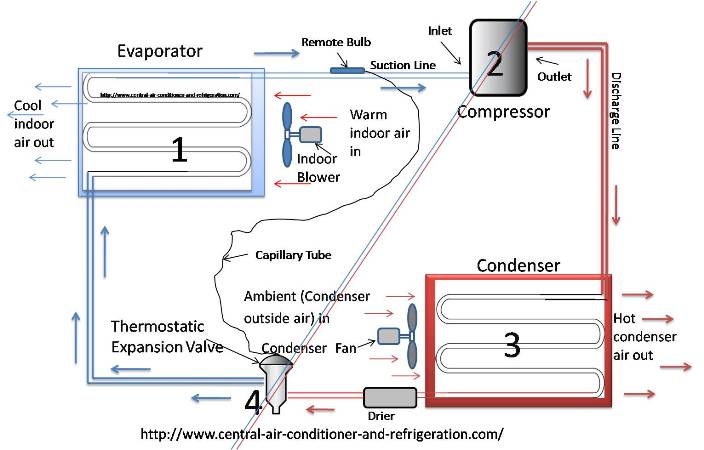
Air conditioners are heat pumps. During the summer, when outside air temperatures are higher than the temperature inside a building, air conditioners use electricity to transfer heat from the cooler interior of the building to the warmer exterior ambient. This process uses electrical energy.
Unlike residential air conditioners, most modern commercial air conditioning systems do not transfer heat directly into the exterior air. The thermodynamic efficiency of the overall system can be improved by utilizing evaporative cooling, where the temperature of the cooling water is lowered close to the wet-bulb temperature by evaporation in a cooling tower. This cooled water then acts as the heat sink for the heat pump.

Air Conditioner Cycle Diagram 

Deep lake water cooling uses cold water pumped from the bottom of a lake as a heat sink for climate control systems. Because heat pump efficiency improves as the heat sink gets colder, deep lake water cooling can reduce the electrical demands of large cooling systems where it is available. It is similar in concept to modern geothermal sinks, but generally simpler to construct given a suitable water source.

Deep lake water cooling allows higher thermodynamic efficiency by using cold deep lake water, which is colder than the ambient wet bulb temperature. The higher efficiency results in less electricity used. For many buildings, the lake water is sufficiently cold that the refrigeration portion of the air conditioning systems can be shut down during some environmental conditions and the building interior heat can be transferred directly to the lake water heat sink. This is referred to as "free cooling", but is not actually free, since pumps and fans run to circulate the lake water and building air.
One added attraction of deep lake water cooling is that it saves energy during peak load times, such as summer afternoons, when a sizable amount of the total electrical grid load is air conditioning.

DWCS Diagram 

Advantages

Deep water source cooling is very energy efficient, requiring only 1/10 of the average energy required by conventional cooler systems. The energy source is fully renewable, provided that the heat brought to the lake does not disturb its natural cycles. It does not use any ozone depleting refrigerant.
Depending on the needs and on the water temperature, couple heating and cooling can be considered. For example, heat could first be extracted from the water (making it colder); and, secondly, that same water could cycle to a refrigerating unit to be used for effective cold production.

Disadvantages

Deep water source cooling requires a large and deep water quantity in the surroundings. To obtain water in the 3 to 6 °C (37 to 43 °F) range, a depth of 50 m (160 ft) to 70 m (230 ft) is required, depending on the local conditions.
The set-up of a system is expensive and labour-intensive. The system also requires a great amount of source material for its construction and placement.

First System In Canada

Since August 2004, a deep lake water cooling system has been operated by the Enwave Energy Corporation in Toronto, Ontario. It draws water from Lake Ontario through tubes extending 5 kilometres (3.1 mi) into the lake, reaching to a depth of 83 metres (272 ft). The deep lake water cooling system is part of an integrated district cooling system that covers Toronto's financial district, and has a cooling power of 59,000 tons (207 MW). The system currently has enough capacity to cool 3,200,000 square metres (34,000,000 sq ft) of office space.
The cold water drawn from Lake Ontario's deep layer in the Enwave system is not returned directly to the lake, once it has been run through the heat exchange system. The Enwave system only uses water that is destined to meet the city's domestic water needs. Therefore, the Enwave system does not pollute the lake with a plume of waste heat.

Wednesday, 4 December 2013

Li-Fi Revolution - Wireless Data Transmission Of The Future

Professor Harald Haas coined the term Li-Fi and is at the forefront of research into the new technology.
Li-Fi, an alternative to Wi-Fi that transmits data using the spectrum of visible light, has achieved a new breakthrough, with UK scientists reporting transmission speeds of 10Gbit/s – more than 250 times faster than ‘superfast’ broadband.

The fastest speed previously reported was 3Gbit/s, achieved earlier this year by the Fraunhofer Heinrich Hertz Institute in Germany. Chinese researchers also claimed this month to have produced a 150Mbp/s connection, but some experts were doubtful without seeing further proof.

The term Li-Fi was coined by Edinburgh University's Prof Harald Haas during a TED talk in 2011 (see below for video) though the technology is also known as visible light communications (VLC).

Many experts claim that Li-Fi represents the future of mobile internet thanks to its reduced costs and greater efficiency compared to traditional Wi-Fi.

Both Wi-Fi and Li-Fi transmit data over the electromagnetic spectrum, but whereas Wi-Fi utilises radio waves, Li-Fi uses visible light. This is a distinct advantage in that the visible light is far more plentiful than the radio spectrum (10,000 times more in fact) and can achieve far greater data density.


Li-Fi signals work by switching bulbs on and off incredibly quickly – too quickly to be noticed by the human eye. This most recent breakthrough builds upon this by using tiny micro-LED bulbs to stream several lines of data in parallel.

The research was carried out by the Ultra Parallel Visible Light Communications project, a joint venture between the universities of Oxford, Cambridge, Edinburgh, St Andrews and Strathclyde, and funded by the Engineering and Physical Sciences Research Council.

Existing LED light bulbs could be converted to transmit Li-Fi signals with a single microchip, and the technology would also be of use in situations where radio frequencies cannot be used for fear of interfering with electronic circuitry.

And although Li-Fi bulbs would have to be kept on to transmit data, the bulbs could be dimmed to the point that they were not visible to humans and yet still functional. One draw-back is that the data receiver would have to be in sight of the transmitter-bulb as visible light does not penetrate solid materials.

The makers of Li-Fi note that this quality might actually be an advantage in some scenarios, making Li-Fi more secure than Wi-Fi with hackers unable to access unsecured internet connections from out of sight of the transmitter.